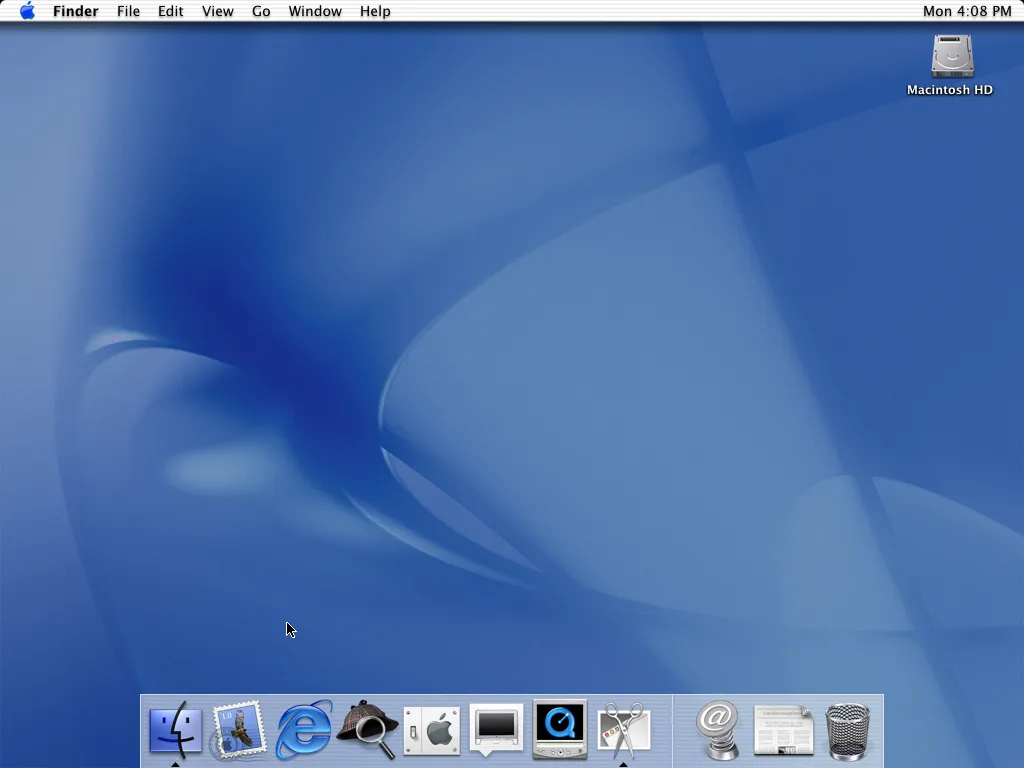



Mac OS X 10.0
Mac OS X 10.0 (code named Cheetah) is the first major release of macOS, Apple's desktop and server operating system. It was released on March 24, 2001, for a price of $129 after a public beta.

Developed by: Apple Computer
General availability: March 24, 2001 (version 10.0 build 4K78)
Last release: June 22, 2001 (version 10.0.4 build 4S10)
Preceded by: Mac OS 9
Succeeded by: Mac OS X 10.1 (codename Puma)
Kernel type: Hybrid (XNU)
Working state: Historical and no longer supported
Mac OS X was Apple's successor to the classic Mac OS. It was derived from NeXTSTEP and FreeBSD, and featured a new user interface called Aqua, as well as improved stability and security due to its new Unix foundations. It introduced the Quartz graphics rendering engine for hardware-accelerated animations. Many technologies were ported from the classic Mac OS, including Sherlock and the QuickTime framework. The core components of Mac OS X were open sourced as Darwin.
Boxed releases of Mac OS X 10.0 also included a copy of Mac OS 9.1, which can be installed alongside Mac OS X 10.0, through the means of dual booting (which meant that reboots are required for switching between the two OSes). This was important for compatibility reasons; while many Mac OS 9 applications could be run under Mac OS X in the Classic environment, some, such as applications that directly accessed hardware, could only run under Mac OS 9.
Six months after its release, Mac OS X 10.0 was succeeded by Mac OS X 10.1, code named Puma.
Features
New and updated features
- The features of the release include the Dock which was a new way of organizing one's Mac OS X applications on a user interface, and a change from the classic method of application launching in previous Mac OS systems.
- It included Terminal, a terminal emulator that provides access to Mac OS X's Unix command-line interface; the classic Mac OS had previously had the distinction of being one of the few operating systems with no command line interface.
- The new Mail email client included the ability to configure the software to receive all of a user's email accounts in one list, the ability to file emails into folders, the ability to search for emails, and the ability to automatically append signatures to outgoing emails.
- The Address Book was a new application which had features including exporting and importing cards to and from vCard format, API to interface with other applications, change of address notifications, contact groups, auto-merge when importing vCards, customizable fields and categories, the automatic formatting of phone numbers.
- TextEdit replaced the SimpleText application with new features.
- PDF support was added; it allows the user to create PDFs from any application.
- The OS introduced the new Aqua UI.
- Several features of Mac OS 9 were ported to Mac OS X, including the Sherlock desktop and web search engine.
Removed features
- File-sharing client: The system can only use TCP/IP, not AppleTalk, to connect to servers sharing the Apple Filing Protocol. It cannot use SMB to connect to Windows or Samba servers.
- File-sharing server: As a server, the system can share files using only the Apple Filing Protocol (over TCP/IP), HTTP, SSH, and FTP.
- Optical media: Neither DVD playback nor burning CDs or DVDs is supported. However, audio CD burning was added in the Mac OS X 10.0.2 update, roughly two months after initial release.
Architecture
Mac OS X is built on Darwin, a Unix-like operating system derived from FreeBSD. Darwin includes a new kernel, XNU, derived from Mach and BSD, as a replacement for the Mac OS nanokernel used in classic Mac OS.
Unlike Mac OS 9, Mac OS X has protected memory and preemptive multitasking. This means that if an application's memory becomes corrupted due to a bug, the application will crash without the entire system crashing and needing to be rebooted.
Mac OS X also had support for OpenGL, AppleScript, and the Carbon and Cocoa APIs.
Release History
| Version | Build | Release Date | Darwin Version | Release Notes |
|---|